The Hidden Sister of Isis & The Art of Shadow Work
Everyone knows Mary Magdalene. Far fewer people know Martha, the sister tradition placed beside her. When I bring Martha up, I usually get a pause. Wait. Mary Magdalene had a sister?
I've come to feel the same way about Nephthys. Isis is one of the most beloved goddesses of ancient Egypt, but she had a sister too, and when I mention her, I get that same look. Who's that?
Nephthys appears in the myths, but almost as a side note. You can find her in the temples, but she's never the main event. Always the bridesmaid, never the bride. That's exactly what drew me to her. I wanted to know what the ancient Egyptians knew about her, how they honored her, and what she has to offer those of us today who feel called to the Neteru and their mysteries.
Who Is Nephthys? The Egyptian Goddess We Forget
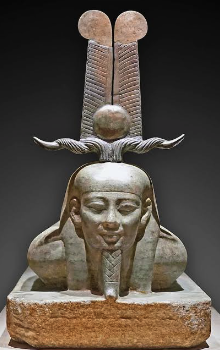
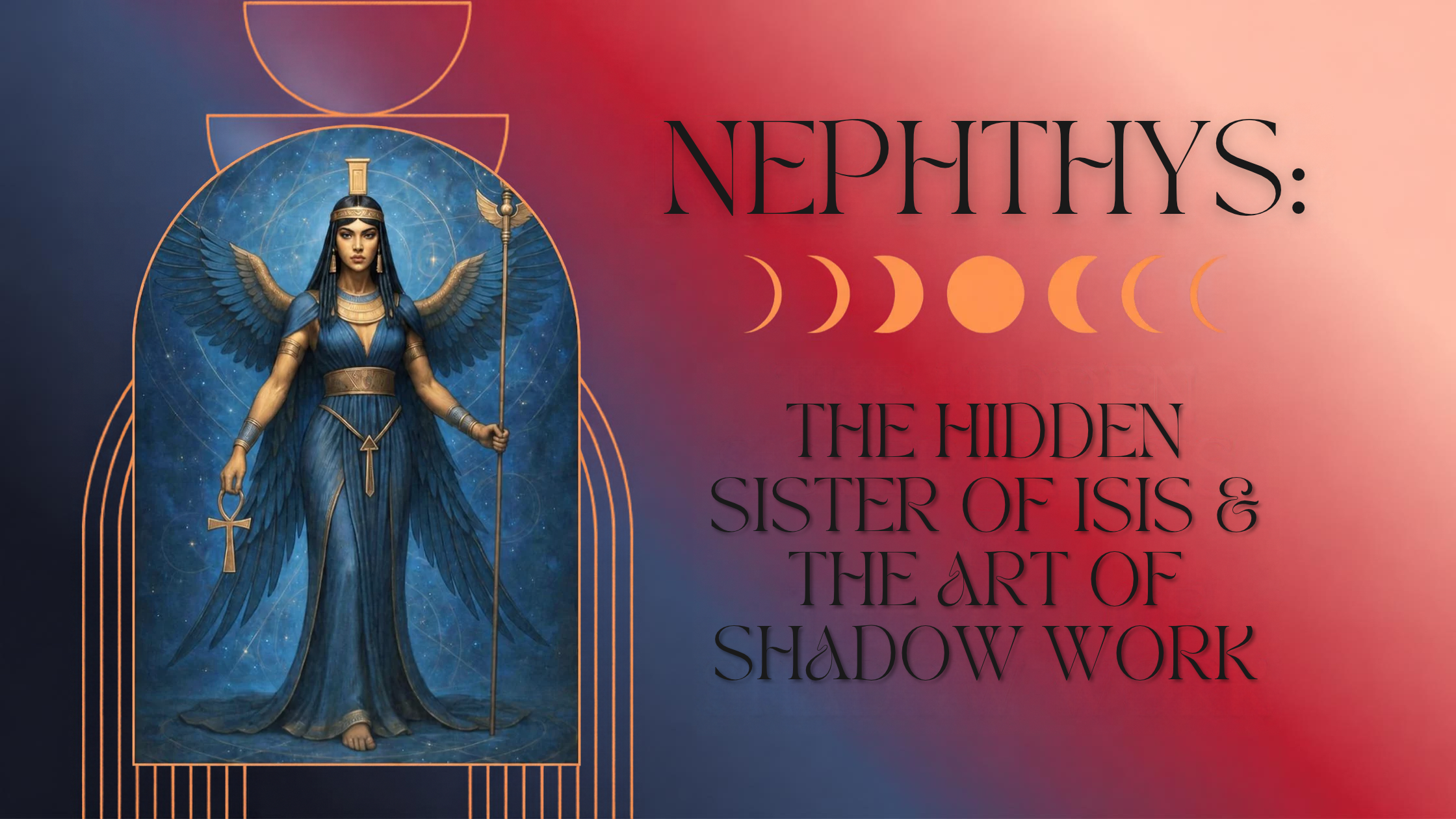
Nephthys is the ancient Egyptian goddess of the night, mourning, protection, and the passage between death and rebirth. Her Egyptian name, Nebet-Het, means "Lady of the House" or "Lady of the Temple."
You probably know her better than you realize. Most of us know the story of Isis, Osiris, and Set, but we forget there were four siblings, children of Nut, the sky, and Geb, the earth. Isis married Osiris. Set married Nephthys.
When Set murdered Osiris and scattered the pieces of his body across Egypt, Isis set out to find them. What we forget is that Nephthys searched right alongside her. The two sisters took the form of kites, birds of prey with a piercing, mournful cry, and flew over the land looking for their brother. Nephthys gathered the pieces with Isis, and in the ancient Lamentations of Isis and Nephthys, it's both sisters' voices, together, that call Osiris's soul back to his body.
Sit with that for a moment. Her own husband tore this family apart, and she chose to help put it back together.The Lie They Both Carried
Here's where it gets personal for me, because both of these women were diminished in almost identical ways, long after they'd earned their place at the center of the story.
Magdalene's case is well documented, which somehow makes it worse. In 591 AD, Pope Gregory I gave a homily where he conflated her with two other, unnamed women in the Gospels, an anonymous “sinful woman” and Mary of Bethany. From that one sermon, the myth of Mary Magdalene as a repentant prostitute took hold and stuck for nearly 1,400 years. The Catholic Church didn't formally correct the record until 1969. The Eastern Orthodox Church, notably, never bought into it at all, they called her Apostle to the Apostles the whole time.
Isis was diminished differently, but it was the same story wearing different clothes. Her worship, in her older and rawer forms, carried real ferocity, real sexuality, real magic that wasn't polite or safe. As her cult spread through Greece and Rome, and later as Christianity absorbed and replaced it, that rawness got smoothed into something tamer. The wild, grieving, spell-casting goddess who reassembled a body with her bare hands became, over centuries, a softer figure.
Neither woman asked to be softened. Both were, anyway.
Nephthys, the Nursing Mother of Horus
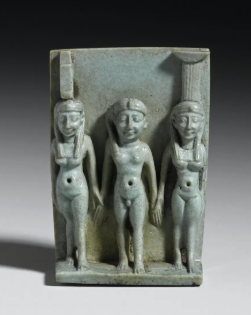
Triad of Isis, the child Horus and Nephthys - Brooklyn Museum
After Isis conceived their son, Horus, Nephthys stayed close, guarding the infant while he was hidden from Set. The Pyramid Texts, among the oldest religious writings in the world, call Isis his birth mother and Nephthys his nursing mother.
Today that can sound like the lesser role. In ancient Egypt, it wasn't. Tutankhamun's wet nurse, Maia, was given her own tomb at Saqqara, where a relief shows the young king sitting in her lap while others come to pay him homage. One of her titles was "educator of the god's body."
Nephthys was seen as the nurse of every reigning pharaoh, the one who nourished and protected the living king. So when the Pyramid Texts name the two sisters side by side, they aren't ranking them. Isis brings life into the world. Nephthys sustains it and keeps it safe.
What the Temple Reliefs Tell Us About Nephthys
Late temple texts honor her at Edfu, Dendera, Philae, Kom Ombo, and Esna, and Ramesside pharaohs left inscriptions to her at Karnak and Luxor, where she had altars within the complex. One of my favorite details is at Edfu, where she grants the pharaoh the power to see what is hidden by moonlight. She isn't absent from these temples. She's quietly present, waiting to be noticed.
How Nephthys Was Honored
It's easy to assume Nephthys was only ever a supporting character. The historical record says otherwise.
In the reign of Ramesses II, a temple called the "House of Nephthys" stood within the sacred precinct of Set at Sepermeru, south of the Fayyum. An ancient tax record, the Papyrus Wilbour, shows that her temple owned its own fields, was run separately from Set's, and was served by two prophets of Nephthys whose names survive: Penpmer and Merybarse.
There's an even more human glimpse in another papyrus. A priest named Pra'emhab wrote to the vizier complaining about his taxes and his workload. He was already running the temple of Set, he said, and he was responsible for the House of Nephthys too, on top of a heap of other temples. More than three thousand years later, an overworked priest is part of our proof that she had a house of her own. Her worship lasted, too. In the Roman period, a temple at Komir, just south of Esna, was dedicated to Nephthys and Anuket, with hymns to both goddesses carved on its walls.
What about priestesses? There's no evidence of a mystery school devoted to Nephthys alone. What we do have is something I find even more moving: a sacred role for women at the heart of the Osiris mysteries. The Songs of Isis and Nephthys and the Lamentations of Isis and Nephthys were performed at the festivals of Osiris by two women who embodied the sisters. The names Isis and Nephthys were to be written on their arms, and in the Songs they carried tambourines as they sang. The Lamentations were recited in the house of Osiris, lord of Abydos.
At Abydos, Nephthys joined Isis as a mourner in the Osireion, the mysterious sunken structure behind the Temple of Seti I. She had no cult of her own there, but no Osiris rite was complete without her. When we stand at Abydos, we're standing where women once lent their bodies and voices to these two sisters.
The Gifts and Powers of Nephthys
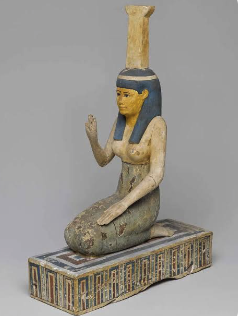
She is the goddess of the night. Her domain is darkness and the dangerous edges of the desert. The Pyramid Texts pair the sisters as two halves of one cycle: you rise with Isis on the boat of the day, and you descend with Nephthys on the boat of the night.
She guards the soul. Temple texts call her the "Helpful Goddess" and the "Excellent Goddess," and according to the Pyramid Texts, demons trembled before the two sisters, whose spells carried the soul safely through the underworld.
She presides over rebirth. As "Nephthys of the Bed of Life," she watched over the embalming table, where the body was prepared for new life. At Memphis, whose necropolis is Saqqara, she was "Queen of the Embalmer's Shop." In the Pyramid Texts, the king rising to new life throws off the "tresses of Nephthys," an image often understood as his mummy wrappings, as if the dead were held in her own hair until they were ready to rise. She was also the special protector of the Bennu bird, the sacred bird the Greeks later linked with the phoenix.
And she knows joy. At Edfu, Dendera, and Behbeit, the pharaoh offers her beer, and in return she grants him joy with no hangover. The same goddess who keeps vigil over the dead also knows how to celebrate.
What Nephthys Can Teach Us About Shadow Work
The Egyptians didn't use the word "shadow." That's Carl Jung's language. But everything they tell us about Nephthys points us there.
I believe the myths and the Neteru are mirrors. They reflect back what we need more of in our own lives, and they show us why and how. Isis is the sister we're taught to become: radiant, magical, seen. Nephthys mirrors what we've mostly been taught to avoid.
he goes down into the dark. So many women on the spiritual path learn to stay positive and lead with love and light. There's beauty in that, but light becomes a mask when we use it to avoid what hurts. Nephthys reminds us the night boat is part of the cycle too, and she sees what's hidden there: the resentment we don't admit to, the grief we keep stepping around, the dream we buried so long ago we've forgotten it was ours.
She gathers what was scattered. Jung described the shadow as the parts of ourselves we cut off, often early in life, to be loved or to keep the peace. The girl who learned at eight that her anger wasn't welcome. The woman who stopped singing because someone laughed. Nephthys models the patient work of bringing those pieces home.
She stays in relationship with what destroys. Most of us carry a little Set inside, the part that sabotages or burns things down. Shadow work doesn't ask us to pretend it isn't there. It asks us to know it well enough that it no longer runs our lives.
She makes grief holy. The woman who cries in the car so no one at home sees her. The daughter caring for an aging parent with no room for her own sorrow. In Nephthys's story, grief voiced out loud is the very thing that calls the soul back to life.
There's one more story about Nephthys, and it surprised me most. It comes from the Greek writer Plutarch, who recorded his version of the Osiris myth around 100 CE. In his telling, Osiris lay with Nephthys, mistaking her for Isis. She conceived a child and, afraid of Set, abandoned the baby. Isis searched for him, found him, and raised him as her own. That child was Anubis, the jackal god who became the guardian of the dead. Later retellings even make that night the reason Set murdered Osiris. Either way, the sister whose choices wounded Isis is the same sister who knelt beside her to gather Osiris back together, and Isis let her. Nephthys isn't the perfect sister. She made choices she had to live with, and then she chose to show up anyway.
A Message From Nephthys
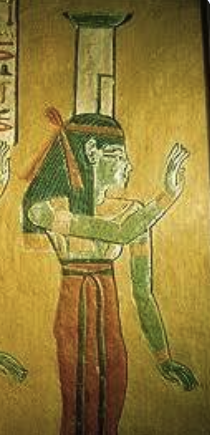
When I sat down to channel Nephthys, I asked her about the things the ancient record tells us she did: carrying souls through the underworld, guarding the breath, watching over the time between death and rebirth, and grieving alongside those who mourn. Here is some of what she shared.
On moving through our own dark passages:
“You need to be re-sourced by Source. During a dark passage, an uncertain transition, your faculties are over-run with fear and the chaos fear creates. Come back to breath. In moments of "death," choose life. Breath is the elixir. It quells fear. It connects you to all that is.”
On why she guarded the lungs:
“Breath is life. Breath is the river of light that runs through your body, animating it. Breath runs through all things and animates all things. Breath is your greatest currency.”
On the unseen time between an ending and a beginning:
“You are being re-made. Re-crafted. Re-fashioned according to where you are now, where you've been, and where your soul must go. You perceive this time as a time when you are kept in the dark. Stifled, even. And yet this couldn't be further from the truth. You are actually being taught, prepared, held, and counseled by the Mother. By Creation herself. And you will not be born again until you are equipped for the new journey. That type of protection is love.”
On grief:
“The heart hurts. The chest constricts. The anger bubbles beneath the surface. It is all part of it. All of the uncomfortable parts of being human. The parts you were taught to ignore, to get through quickly, to not show to others because it would make them uncomfortable. Grief is one of the greatest catalysts of change, growth, inner strength, and clarity. It is meant to crack you open, to teach you about the greatest depths of love. I tell you, grieve however you like. But do it as witness. Feel all of it. And learn from all of it.”
On how we can be that presence for one another:
“Love someone enough to sit in the discomfort with them. Have the courage to take the journey with them. Beside them. Don't feel the need to fix. That is not your job. Presence, not pressure.”
How to Work With Nephthys: A Shadow Work Practice
You don't need to be in Egypt to meet Nephthys. She's the goddess of the night, so the simplest way to begin is to give her some of yours.
Begin under her wings. Choose an evening when you won't be interrupted. Light a single candle or sit by the moonlight, close your eyes, and come back to your breath, as Nephthys reminded me. Let each slow breath quiet the fear. Then imagine her behind you, her great wings folding around you. Feel held and guarded before you look at anything hard.
Ask what is hidden. When you feel settled, ask quietly, "Nephthys, what is hidden from me?" Then wait. The answer may come as an image, a memory, a feeling in your body, or a single word. Don't analyze it. Just notice it, and write it down when you open your eyes.
Gather one piece. What did you love at eight or ten that you let go of? Maybe you sang all the time, or danced in the kitchen, or said exactly what you thought. Welcome one of those pieces back this week in a small, real way. Sing in the car. Dance to one song before anyone else is awake. Nephthys gathered Osiris one piece at a time.
Let your grief have a voice. Her priestesses didn't grieve silently. They sang. Find a private place, rest a hand over your heart, and let a sound come out: a hum, a sigh, a few notes of a song. Stay with it for a few minutes and let it change as it wants to. When you finish, return to her wings, thank her, and blow out the candle.
Journaling Prompts for Working With Nephthys
What have I been unwilling to look at?
Which parts of me have I scattered or cut off to keep the peace?
What grief have I never allowed myself to voice?
Where am I living in someone else's shadow, and what power is waiting for me there?
Go gently. Shadow work can stir up more than we expect, and you don't have to face everything in one night. If something heavy surfaces, reach out to someone you trust, a friend, a healer, or a therapist. Nephthys never did this work alone either. She had her sister beside her.
Meeting Nephthys at Abydos
Nephthys has waited a long time to be noticed. Not as the bridesmaid or the shadow behind her sister, but as the one who stays in the dark with us until we're ready to rise.
If she's stirring something in you, I'd love for you to meet her where her voice was once given to the world. From March 30–April 10, 2027, I'm leading Rise Priestess Rise, a 12-day pilgrimage through Egypt's sacred temples, from Saqqara and the Great Pyramid to Philae, Dendera, and Karnak. At Abydos, we'll gather at the Osireion, where priestesses once sang as Isis and Nephthys, and do our own sacred work of release.
You can learn more and reserve your place at danielleartigo.com.