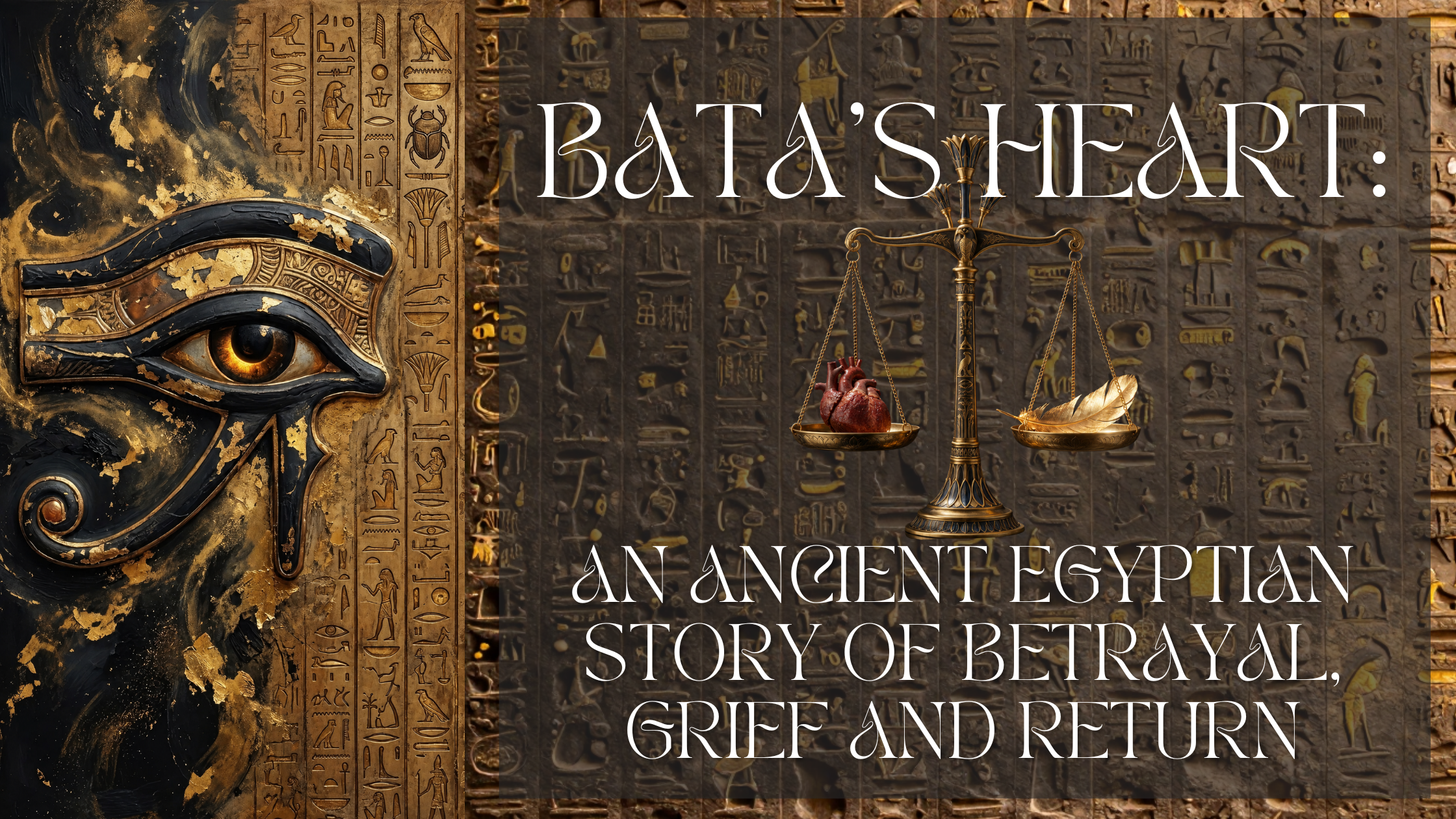
Have you ever been betrayed by someone you loved deeply? A friend, a family member, someone you believed was your confidante, your safe harbor? Maybe it wasn't only that they hurt you. Maybe they believed something about you that wasn't true, and you had to watch them look at you and see someone you're not.
The ancient Egyptians knew this heartbreak well enough to write a story about it. It's called the Tale of Two Brothers, an ancient Egyptian story of betrayal, grief, and return, and honestly, it reads like a modern-day soap opera. It was copied onto papyrus over 3,000 years ago, and that papyrus now sits in the British Museum. It's one of the oldest fairy tales in the world, and it holds one of the most beautiful images I know for what we do with our hearts when the people closest to us break them.
The Tale of Two Brothers:
Anubis and Bata
Once there were two brothers. The older of the two was named Anubis, not to be confused with the jackal god who guards the dead and watches over embalming. The younger was Bata. Anubis had a house and a wife, and Bata lived with them almost like a son. He plowed the fields, he cared for the cattle, and he was so good at his work that there was no one like him in all the land. The cows even spoke to him, telling him where the sweetest grass grew.
It was a good home. Until the day it wasn't.
One afternoon Bata came in from the fields for supplies, and his brother's wife was alone in the house. She'd been watching him for a while, and finally her desire for him became overwhelming. He was young and strong, and this seemed like the perfect time to seduce him. So she made her move. Come lie with me for an hour, she told him, and I'll make you beautiful new clothes.
Bata refused her. You're like a mother to me, he told her, and my brother is like a father. After turning her away, he promised to keep this conversation between the two of them, and went back to his work in the fields.
But she was afraid, and her shame turned into something sharper. When Anubis came home that evening, he found his wife lying in the dark, pretending she'd been beaten. She told him that Bata had tried to force himself on her.
And Anubis, as all good husbands would, believed her.
He grabbed his blade and hid behind the stable door to wait for his brother. As Bata drove the cattle home, the lead cow stopped at the door and said, Your brother is waiting to kill you. Bata looked under the door, saw his brother's feet, and ran.
Anubis chased him. Bata cried out to the sun god Re-Horakhty for justice, and the god answered by setting a river full of crocodiles between them. All night the brothers waited on opposite banks.
At dawn, Bata told the truth across the water. Then, to prove he'd never touched his brother's wife, he took a sharp reed, cut off his own manhood, and threw it into the river, where a catfish swallowed it. Anubis finally saw what he'd done. He wept, but he couldn't cross the water to reach his brother.
But Bata wasn't coming home. He told his brother he was leaving for the Valley of the Cedar, and that once he got there, he'd take his heart out of his body and tuck it into the highest blossom of a cedar tree, where no one could reach it. If that tree was ever cut down, Anubis would have to come and find his heart. And how would he know? His jar of beer would suddenly froth over. That would be the sign.
Anubis went home, killed his wife, threw her body to the dogs, and mourned his brother.
In the valley, the gods took pity on Bata's loneliness and made a wife for him, more beautiful than any woman in Egypt. He trusted her with his secret, the place where his heart was hidden. He also warned her never to go out by the sea, because it might carry her away. One day she went anyway. The sea rose up after her, and the cedar caught a single lock of her hair and gave it to the water. The waves carried that lock all the way to Egypt, where it washed up at the place where Pharaoh's linens were laundered. Soon all of Pharaoh's clothes smelled of her perfume. His wise men told him the hair belonged to a daughter of the sun god, and Pharaoh had to have her.
He sent soldiers to the Valley of the Cedar, and Bata killed them. So Pharaoh tried something else. He sent a woman carrying beautiful jewelry, and Bata's wife followed the jewels straight back to the palace. Pharaoh adored her and made her his great lady. And the first thing she asked of him was to cut down the cedar tree that held her husband's heart.
Pharaoh's men cut the cedar down. Bata fell dead in the same moment.
Far away, Anubis's beer frothed in its jar.
Anubis took up his staff and his sandals and went looking for his brother. He found Bata lying dead on his bed in the valley, but his heart was gone. He searched for three years. Then he searched for four more. In the seventh year, he found a single seed, and it was Bata's heart. He placed it in a bowl of cold water, and as the heart drank, Bata's body began to tremble. Anubis gave him the water to drink, the heart settled back into his chest, and Bata lived again.
Bata wasn't finished with his wife. He told Anubis he would turn himself into a magnificent bull, and he asked his brother to ride him to Pharaoh's palace, where Anubis would be rewarded with silver and gold. Pharaoh was delighted with the bull and celebrated it as a great wonder.
Then one day, the bull walked right up to the great lady and spoke to her. Look at me, he said. I'm still alive. I'm Bata. You knew when you had the cedar cut down that you were killing me, and here I am.
She was terrified. While Pharaoh was drinking with her in a happy mood, she made him swear to give her anything she asked. Then she asked to eat the bull's liver. Pharaoh was grieved, but he'd sworn an oath, so the bull was sacrificed. As it died, two drops of its blood fell beside the palace doorway, and by morning two great persea trees had grown there.
Some time later, as she passed the trees, one of them spoke to her. I'm still alive, it said. It was Bata again. So she did the same thing a second time. She waited for a happy moment, made Pharaoh swear another oath, and asked him to cut down the trees and make them into furniture. As she stood watching the carpenters work, a splinter flew into her mouth. She swallowed it, and she conceived a child. That child was Bata himself, born again.
Pharaoh had no idea. He loved the boy as his own son and named him heir to the throne. When Pharaoh died, Bata became king of Egypt. Then he called his officials together and had the great lady brought before them, the woman who had been his wife and was now also his mother. He told them what she had done, and they passed judgment on her.
And Anubis, the brother who had once hunted him with a knife, was made his heir. Bata ruled Egypt for thirty years, and when he died, Anubis took his place.
Why the Egyptians Told the Tale of Two Brothers
So why did this story matter enough to be written down over 3,000 years ago? Scholars still debate it, and honestly, that's part of the fun. It was even the first ancient Egyptian text that modern Egyptologists called literature. Some read it as royal drama in disguise. The papyrus was copied while Seti II was still crown prince, in an era when he'd end up in a bitter fight for the throne with a rival named Amenmesse, who may have been his own half brother. Two brothers, a family torn apart, a crown at stake. Sound familiar?
Others see a teaching about sacred kingship. Bata's wife becomes his mother, and he's reborn through her as the rightful king, chosen and protected by the gods even though he isn't the old pharaoh's son. And woven all the way through, I see Ma'at, the sacred order of truth and justice. When Bata is falsely accused, he cries out to the sun god as the one who judges the wicked from the just, and the god answers him. The lie doesn't win. It takes years, and a lot of heartbreak, but in the end, truth takes the throne.
And that's exactly where this story speaks to us now.
What Bata's Heart Teaches Us About Betrayal and Grief
The deepest betrayals usually don't come from strangers. They come from inside the house. For Bata, it wasn't only the lie that broke him. It was that his brother believed it. Maybe you know that feeling. A friend of twenty years repeats a story about you that isn't true, and the people you love nod along. It's a wound to the relationship and a wound to your sense of who you are, both at once.
Betrayal asks us to protect the heart, not close it. Bata doesn't harden. He doesn't swear off love or decide that no one can ever be trusted again. Bata takes his heart out and puts it somewhere high and safe, and then he keeps living. That's a picture of what many of us need after a betrayal: a season of guarding the heart while it heals, without deciding love itself was the mistake.
Some relationships end even when love is still there. Anubis is sorry, and the brothers part with a promise between them. Still, Bata doesn't go home. The life they'd shared in that house was over, and both of them had to grieve it. Releasing a relationship you thought would last a lifetime doesn't mean you stopped loving the person. Sometimes it means you finally stopped expecting them to be someone they've shown you they're not.
The heart comes back slowly, with water. Anubis doesn't force his brother's heart back into his body. He places it in cold water and lets it drink until it swells back into itself. That's how a heart recovers from betrayal and grief. Not all at once, but through small, steady nourishment: rest, tears, a walk outside, a friend who lets you say the same thing for the fourth time.
You can be reborn more than once. Bata is betrayed, and he rises. He's betrayed again, and he rises again, every time in a new form, until he's sitting on the throne. Each loss strips away an old shape, and something truer grows in its place.
I know something about grief that comes in layers. Two years ago, my dad called me around 7 on a Saturday morning. He was out on his acreage in Wyoming, and he'd suddenly lost the feeling in his legs. He'd had to crawl back to the house to call a neighbor, a volunteer firefighter, who got him to the hospital right away. Within 24 hours, he was essentially a paraplegic, and no one could tell us why.
So we grieved. We grieved his health, his strong and active body, and the dad who'd always been so present in our family's life. About eight weeks later, just as we were adjusting to him moving into a nursing home, he died after a minor outpatient procedure. I was the one who made the decision to take him off life support when his body could no longer breathe on its own. Then came another grief entirely, the death of a man who was leaving this life far too soon. And right on its heels came a few days of packing up his belongings, getting his unfinished house ready to sell (he was still building it), wrapping up his estate, and calling family and friends to tell them. It was overwhelmingly sad.
Loss doesn't always arrive just once. Sometimes, like Bata's, it comes again and again, each time in a new form. And healing happens the same way, in waves or spirals. You mend your heart, you move forward, and then the grief comes around again in a wave of emotion, so that more sadness can be released and more emotion can move out of your energy field.
Questions to Sit With
Take your journal and give yourself some quiet time with these:
Where have I been waiting for someone to see me truly, when I can choose to see myself?
What expectation am I ready to set down, even though I still love this person?
What has my grief been asking for that I haven't given it yet?
What new form might be growing out of this loss?
Carrying Bata's Heart to Egypt
The Egyptians believed the heart was the seat of the self, the place where truth lives. Bata's story says that truth can be lied about, hidden, cut down, and even stolen, and it still comes back. It just may come back in a new form.
If you're carrying a betrayal, a loss, or a love that has to end, you don't have to resolve it before we go. Bring it with you. Bring your heart, wherever it's been hiding, and let Egypt be the cold, clear water.
With love, Danielle
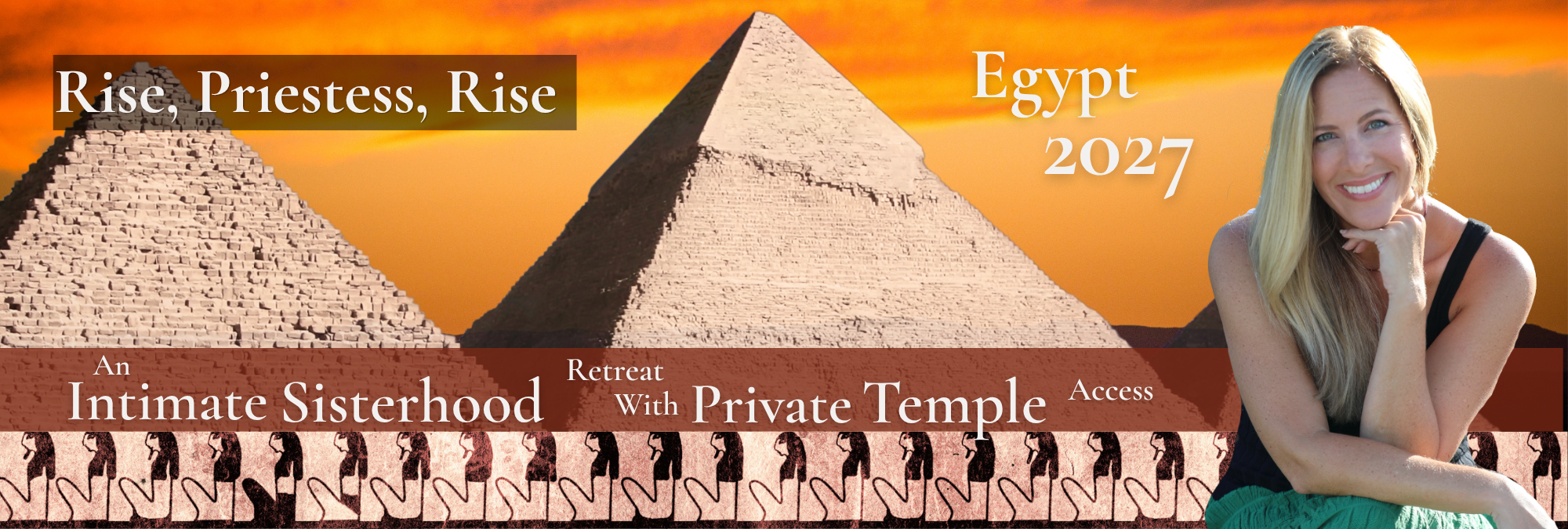
Rise Priestess Rise, our 12-day pilgrimage through Egypt's sacred temples, begins March 30, 2027. Learn more at danielleartigo.com.