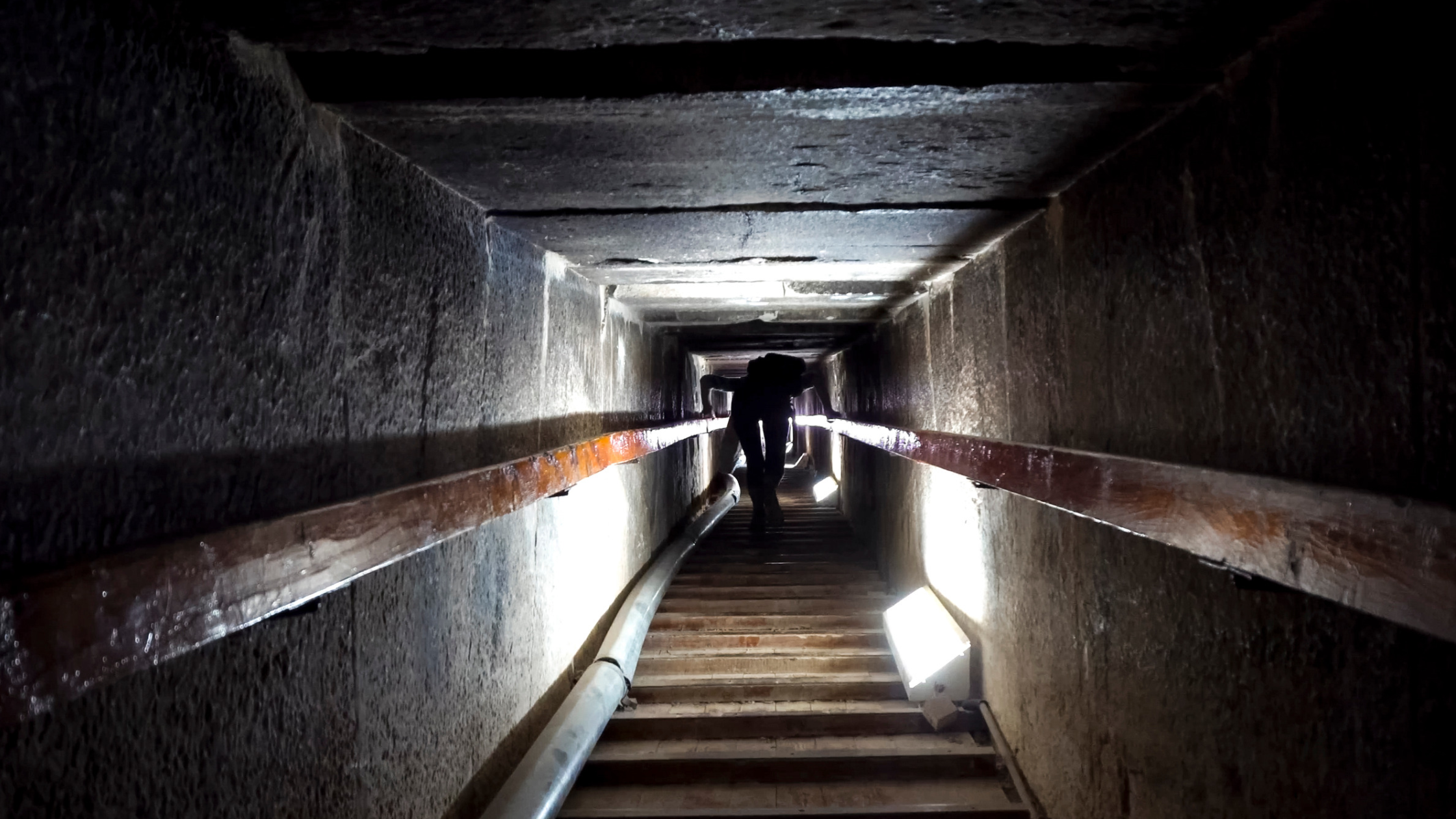
There’s a moment, after the long, steep climb up the Grand Gallery, when you duck beneath a low granite doorway and step into the King’s Chamber. The air is warm and still. The walls are red granite, close and quiet, and the first thing you notice is the sound of your own breath coming back to you.
The last time I brought women into this room, none of us hummed a single note. And I still felt everything in that chamber amplified. Silence in that room isn’t empty. It has its own kind of hum, and you feel it more than you hear it.
One of the women in our Rise Priestess Rise circle asked me to write about sound in the King’s Chamber. She’d heard that humming, chanting and singing there can create a profound energetic experience. She wanted to know whether the ancient Egyptians used sound there on purpose, what’s really happening with the acoustics, and how we might work with it while we’re inside. It’s a beautiful question, and I wanted to approach it with what history and science can tell us, as well as my own channeled information on the topic.
What Is the King’s Chamber? The Granite Heart of the Great Pyramid
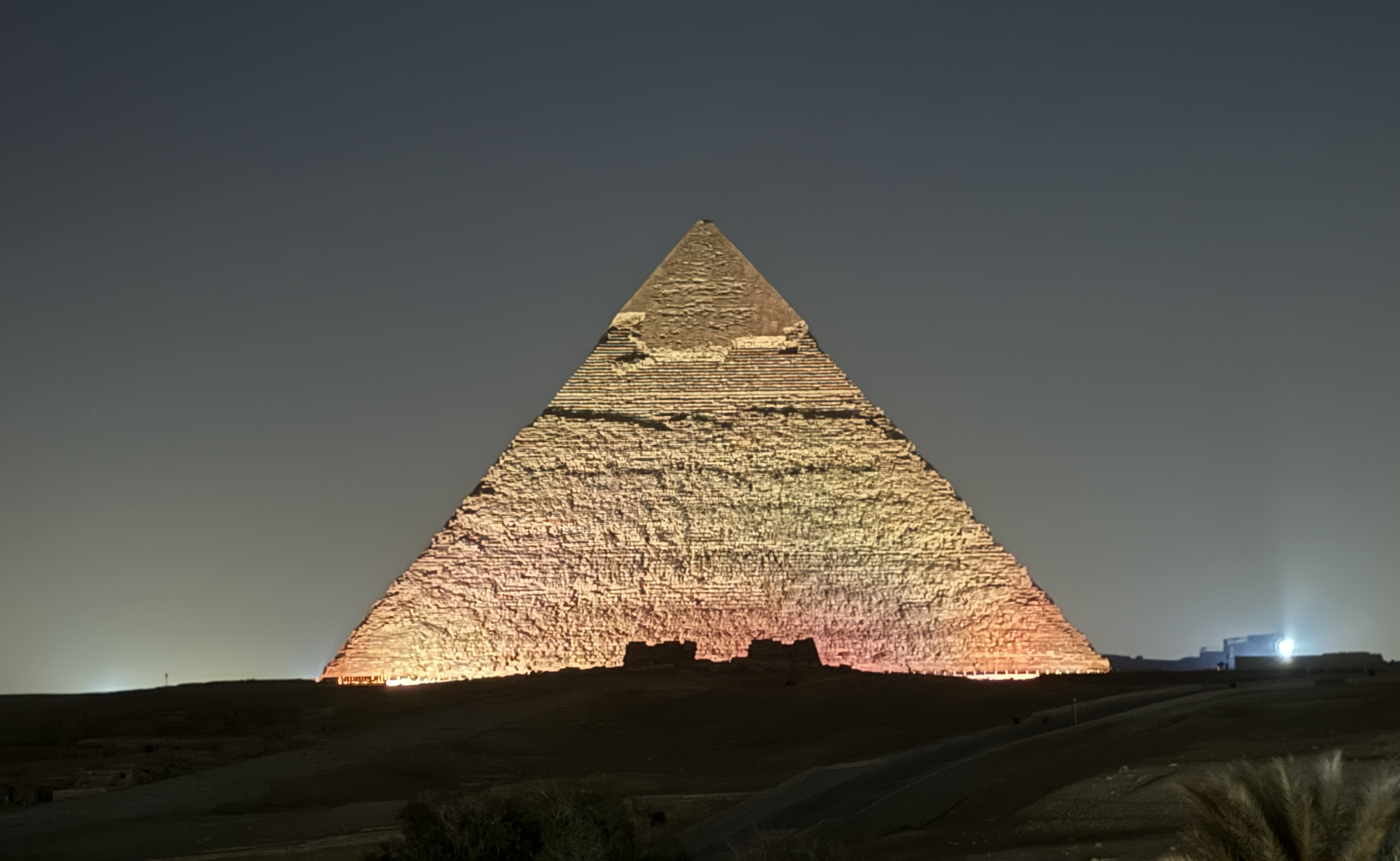
There are three known chambers inside the Great Pyramid of Giza. The deepest is the subterranean chamber, carved into the bedrock beneath the pyramid and left unfinished. It’s rarely open to visitors, so I’m especially grateful our private visit includes it. Higher up, in the middle of the pyramid, is the Queen’s Chamber. Despite the name, no queen was ever buried there. And at the very top is the King’s Chamber, where we’ll spend most of our time.
The King’s Chamber was built for the pharaoh Khufu around 4,500 years ago. It’s a simple rectangular room lined entirely in red granite, brought down the Nile from the quarries at Aswan, about 500 miles to the south. At the west end sits a lidless granite sarcophagus.
The pyramid itself is aligned to north, south, east and west with astonishing precision, off by only a tiny fraction of a degree. Two narrow shafts run from the King’s Chamber up through the stone. In the 1960s, astronomer Virginia Trimble and architect Alexander Badawy noticed that when the pyramid was built, the southern shaft pointed roughly toward Orion’s Belt, the stars the Egyptians connected with Osiris. The northern shaft pointed toward the stars that circle the north pole and never set. One leading theory is that the shafts were meant to help the king’s soul rise to the stars. You may also hear that the three pyramids of Giza are laid out like the three stars of Orion’s Belt. That’s a fascinating theory from the 1990s, but most astronomers and Egyptologists don’t accept it.
Here’s something many people don’t realize. The King’s Chamber has no inscriptions at all. No hymns, no spells, no carved instructions. That’s actually normal for its time. Pyramid burial chambers in Khufu’s era were left plain. Carved spells, known as the Pyramid Texts, only begin appearing about 200 years later, in the pyramid of Unas.
Egyptologists understand the King’s Chamber as Khufu’s burial chamber. The idea that it was a place of initiation comes from the Western esoteric tradition, the spiritual writers and mystery schools of the last two centuries. In that view, the King’s Chamber is a place of spiritual death and rebirth, where an initiate lay in the granite sarcophagus and awakened to a higher consciousness. It’s a powerful way to hold the room, but it comes from those later teachers, not from Egyptian texts. I share that not to take anything away from you, but because I want you to stand in that room knowing what’s true, so that whatever you feel there is fully yours.
Did the Ancient Egyptians Use Sound in the King’s Chamber?
The honest answer is that we don’t know. No ancient text describes humming, chanting or singing inside the King’s Chamber, and there’s no evidence its builders designed it for its acoustics. The granite may have been chosen for strength and permanence, and the sound may simply have come along with it as a gift. That doesn’t mean sound didn’t matter there. It just means we’re honest about where history ends.
So why do so many people connect sound with this room? Partly because of how the room feels, which we’ll get to. And partly because, to the Egyptians, the voice itself was a creative force.
Take Ptah, the creator god of Memphis, the ancient capital just south of Giza. Ptah was also the patron of craftsmen and builders. According to a text called the Memphite Theology, carved on a stone now in the British Museum, Ptah created the world in two steps. First, he conceived everything in his heart. To the Egyptians, the heart was the seat of thought and intention, not just feeling. Then he spoke each thing into being with his tongue. Gods, people, animals, cities, all of it came to life when Ptah named it. Some people compare it to the opening of the Gospel of John: “In the beginning was the Word.”
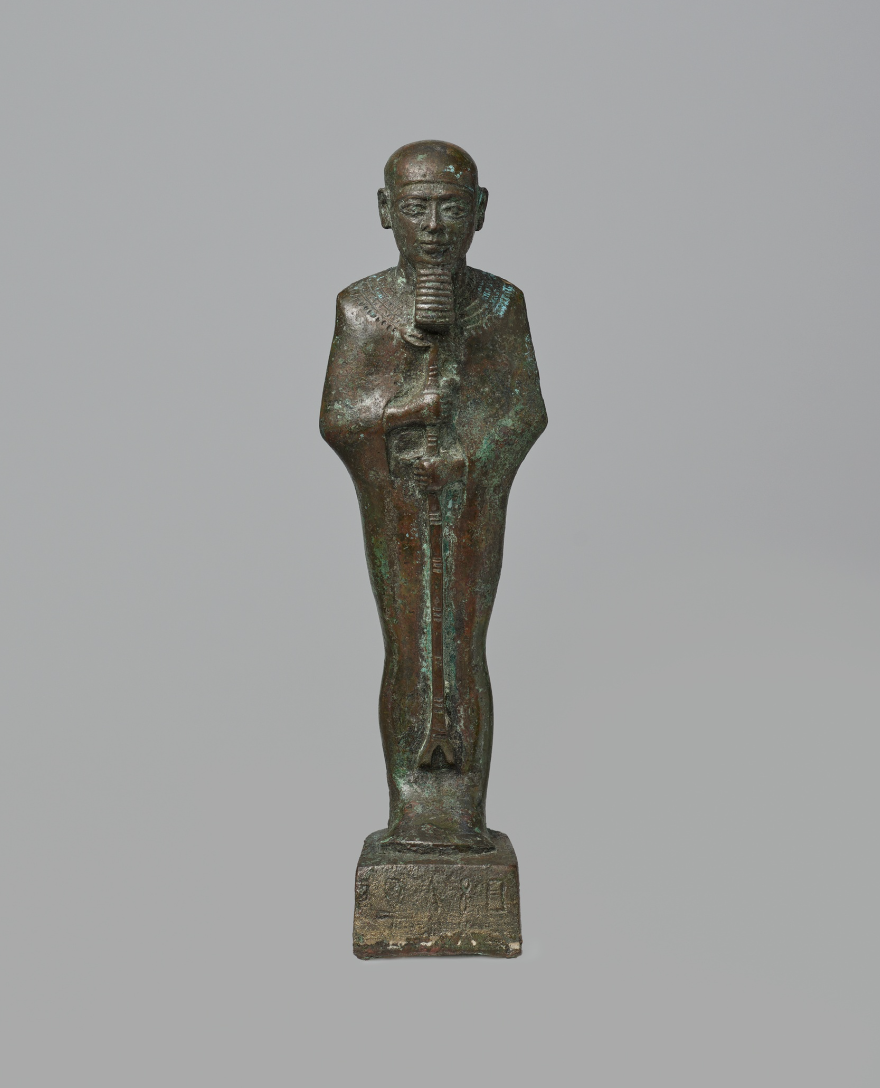
Art Institute of Chicago, “Statuette of Ptah”
Women’s Voices Were Sacred in Ancient Egypt
And in Egypt’s temples, it was often women whose voices carried that creative power. Egyptian temples had singers who held titles like heset and shemayet, usually translated as chantress. They sang in the daily rituals, waking the god in the morning and singing the god to sleep at night. Many were women of high status, including queens. Their voice was a sacred office.
They accompanied themselves with the sistrum, the sacred rattle of Hathor, which women also shook to help revive the dead. You’ll see sistrum-shaped columns at Dendera, the temple of Hathor.
The Egyptians also believed a spoken offering had real power. Tombs carry a formula asking for a voice offering of bread, beer and every good thing. The phrase, peret-kheru, literally means “the going forth of the voice,” and simply reciting it aloud could stand in for a physical offering. The justified dead were called maa-kheru, “true of voice.”
When the Egyptians described Ptah creating with the heart and the tongue, they were describing something we can feel in our own bodies. The heart holds the intention. The voice carries it into form. So many of the women I work with have spent years swallowing their truth, keeping the peace in a meeting, softening what they really meant to say at the dinner table. Remembering that women’s voices once woke the gods can be a powerful step in reclaiming yours. So what happens when you bring that voice into a room made entirely of granite?
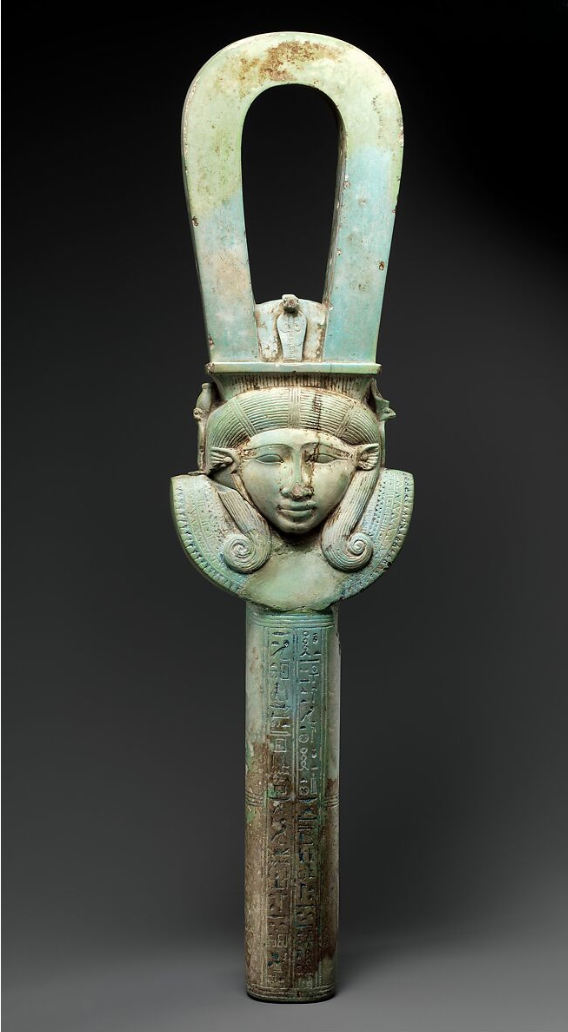
Arc sistrum with a hymn to Hathor - Image © The Metropolitan Museum of Art
King’s Chamber Acoustics: What Researchers Have Measured
What visitors notice first is reverberation. Sound lingers in the King’s Chamber far longer than you’d expect in a room that size, and a single hummed note can seem to fill the whole space and come back to you through your chest and the soles of your feet.
In the 1990s, acoustics engineers Tom Danley and John Stuart Reid brought sound equipment into the chamber. Both reported that the granite sarcophagus and the room resonate at nearly the same frequencies. In other words, they ring at almost the same notes. Reid also did an experiment you can picture. He stretched a thin sheet across the top of the sarcophagus, like the skin of a drum, sprinkled sand on it, and played tones. The vibration made the sand jump and settle into geometric patterns. This is called cymatics.
These were field experiments, not peer-reviewed studies, so hold the numbers loosely. You’ll see claims online that the chamber is tuned to 432 or 528 Hz, and I haven’t found reliable evidence for those. The 2018 study people often share about the pyramid concentrating energy was a computer model of radio waves, not sound.
A room made of granite, with a granite box inside it, will ring like a bell. Granite is so hard that it bounces sound back instead of soaking it up, so your voice has almost nowhere to go but back to you. Whether the builders meant it or not, the effect is profound. Whatever you bring into that room, your voice, your breath, even your silence, comes back to you bigger.
A Message from Thoth
Science can explain why your voice bounces back to you in that room. It can’t explain what you feel when it does. When I asked my own guides about the King’s Chamber before our first pilgrimage in 2025, Thoth came through. This is part of what he shared.
The pyramids were not merely tombs. They were portals, gateways into much higher consciousness, into unification with the heavens, with the solar system, with oneness. Think of it as a highway, a return to oneness. Understand that you are in a chamber of resonance, a portal.
Set an intention to make a connection with the highest energy that you are personally capable of. For some, it might be your higher consciousness. For others, it might be ancestors, angels, the consciousness of the red granite stones that surround you, the consciousness of the elements, the consciousness of the earth beneath you, the consciousness of those who’ve been there before you. All of this is beautiful and potent.
This space is an energetic freeway leading to higher consciousness. Feel with your hands, your body, your tailbone, your feet, with your energy…feel into the resonance, the power of this chamber. It is an absolutely beautiful space to do some toning, if that calls to you. You may feel the urge to do some chanting, meditating, sound bowl playing, sistrum playing, or to simply merge with the energy that is palpably pulsing in and all around you. Allow your body to instruct you on how to move the energy that wants to move so you can make room for the energy that wishes to wash over you, or carry you to higher planes of consciousness.
This is not about opening up a portal to spirits. It’s about sensing your own connection. None of this is about anyone else except you: your connection, your truth, your belief, and what you receive.
Your energy body is one of your greatest allies. It can travel, transport, transmute, clear, reach out, and pull in. Experience the portal, the popping out and going to the apex of this beautiful, phenomenal technology of the pyramid. But then pull this energy back into your third eye, and see how far you can bring it down. Can you pull it down to your feet? Can you pull it down to your heart? Is it hanging out in your crown? Are you able to pull that energy into your throat, where you can actually speak the words?
All will be beautiful. All will be well.
My Experience in the King’s Chamber
That last question, whether you can bring the energy all the way down into your body and your voice, is exactly what I felt in that room. On our first pilgrimage in October 2025, we didn’t hum or tone at all. We began down in the subterranean chamber, cut into the bedrock beneath the pyramid, where we set our intentions and began releasing what we were ready to let go of. Then we climbed to the King’s Chamber. We sat with our backs against the granite walls, lay down, and went into meditation.
The feeling was as if everything was amplified. And that’s exactly why it matters to ground and ascend at the same time. If you don’t anchor, you’ll be tempted to shift your awareness out of your body and up into your light body. The goal is to stay in your body. When you do, you feel connected to everything, and your body feels expansive in every direction at once. There’s no separation between matter and spirit. It’s all connected.
When someone hums in that room, the vibration you feel outside of you enters your body. You can’t tell what’s internal and what’s external anymore. You’re simply vibrating in harmonic resonance with everything around you. To me, that’s divine energy, source energy, humming through the wholeness of your four-body system: physical, emotional, mental, and spiritual. Your consciousness expands.
So you don’t have to hum, dance, or emote at all if you don’t want to. I’ll be honest, toning isn’t really my thing. You can simply sit in this expanded awareness and receive. Some women hum until the granite hums back. Others sit in complete stillness and feel it move through them. Both are the practice.


How to Work with Sound and Silence in the King’s Chamber
You don’t need a trained voice for any of this. Humming counts. Listening counts. Stillness counts.
1. Set your intention before you go in. Choose one word for what you’d like to receive: healing, clarity, your voice. Carry it in your heart as you climb.
2. Arrive in silence. The climb is steep and warm, so give yourself a few minutes to let your breath settle. Let the room speak to you first.
3. Ground and ascend at the same time. Feel your back against the wall or your body on the floor. Imagine roots going down into the earth while your awareness expands upward and outward. Keep coming back to your body. That’s what lets you hold the expansion instead of drifting out of it.
4. Hum, if you feel called to. With your lips closed, hum a low, comfortable note, then slowly slide the pitch up or down. At certain notes you’ll feel the room swell and answer you. There’s no right note. When a group hums together, the voices usually settle onto a shared tone on their own. Breathe whenever you need to, and the others will carry the sound while you do.
5. Try different places in the room. Low notes build up most strongly near the walls and corners, so the same tone can feel very different there than in the center.
6. Make a voice offering. Inspired by the Egyptian peret-kheru, speak a name aloud. An ancestor, a loved one who’s passed, or your own name and an intention for your life. Speak it slowly and let the granite carry it.
7. Rest in the silence. When the sound ends, stay still. Or skip the sound entirely and simply sit in the expanded awareness. The silence is often where the most happens.
8. Be kind to your voice and the space. Gentle volume is plenty. Always follow the guidance of the site guardians and your group leader, including around the sarcophagus, and stay hydrated before and after the climb.
You can start practicing before you ever leave home. A tiled bathroom or shower works on the same principle as granite: hard surfaces that give your voice back. Try humming there for a few minutes a day and notice the note where the room seems to wake up.
Closing
When you’re standing in that red granite room, you don’t need to know the frequency, and you don’t need the history to say it was designed for you. You don’t even need to make a sound. You only need to stay in your body and open to what’s there. The Egyptians believed the voice could create, nourish, and keep a soul alive, and in the King’s Chamber you get to feel that, whether you offer your voice or simply let the stone hum through you.
Think of a moment in your life when silence said more than words could. That’s what the King’s Chamber can feel like.
If you feel called to experience the King’s Chamber for yourself, I’d love for you to explore Rise Priestess Rise, my 12-day sacred pilgrimage through Egypt’s temples, at danielleartigo.com. ONLY 2 SPOTS REMAIN!
And if you’d like to begin with Hathor, the goddess of music and the sistrum, my free Hathor meditation is waiting for you there too.
With love,
Danielle