
EFT Tapping: The Science-Backed Tool for Anxiety, Trauma, and Grounding
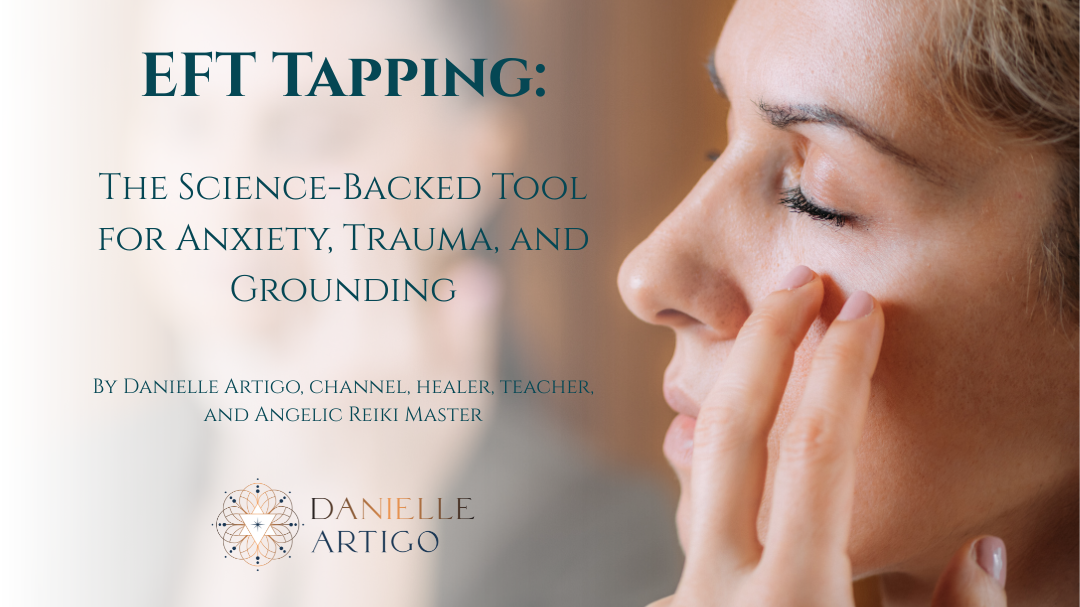
EFT tapping is one of those tools that looks a little strange from the outside, and you really just have to try it to understand.
It is a simple, self-directed practice that combines focused attention on a specific fear, memory, or emotional charge with rhythmic tapping on a sequence of acupressure points. You can do it alone, in five minutes, wherever you are. No equipment, no practitioner, nothing special required. Just your hands and a quiet moment.
I have used it before difficult conversations, after sessions where I absorbed more than I intended to, when grief arrived unexpectedly and had nowhere to go, and when fear was running on a loop that breath alone could not quiet.
It lives in my toolkit for those specific moments, and when I reach for it, I reach for it with full trust. I will be honest with you though, it is not a daily practice for me the way some others are. There are many doors that lead to the same room, and part of this work is figuring out which door is yours. EFT may become one you return to every single day, or one you save for particular moments. Either is perfectly right.
What I can tell you is that the science behind it genuinely surprised me, and the results people experience are often immediate.
Here is where it started
In 1980, a clinical psychologist named Roger Callahan was working with a patient who had one of the most severe water phobias he had ever encountered. She could not look at pictures of water without having a panic response. After years of conventional treatment, she had barely improved.
One day, following a hunch connected to his study of Chinese meridian theory, Callahan asked her to tap on the point directly under her eye. She tapped. The phobia response disappeared. Not dimmed. Gone.
She went outside and splashed water on her face. The fear did not return.
I love this story because it captures exactly what EFT feels like from the inside. Something shifts that you cannot fully explain, and then it is simply not there anymore.
Callahan called his discovery Thought Field Therapy and began developing tapping sequences for different emotional conditions. In the 1990s, a Stanford-trained engineer named Gary Craig simplified the whole thing into what became EFT, using a single standardized sequence that anyone could learn and use on their own.
Since then, EFT has become one of the most studied complementary tools in mental health. It has been used in disaster zones, military programs, trauma clinics, schools, and hospitals on every inhabited continent.
Okay, here is the part that really got me
There are now more than 100 peer-reviewed studies on EFT, and the findings are genuinely hard to ignore. A single one-hour EFT session has been shown to reduce cortisol, the hormone most directly linked to chronic anxiety, by up to 43%. For context, talk therapy and rest produced about 14% in the same study. Nearly half your cortisol, gone, from one session of tapping.
A 2022 systematic review looked at 56 randomized controlled trials and concluded that EFT meets the American Psychological Association's criteria as an evidence-based practice for anxiety, depression, phobias, and PTSD. The effect sizes for PTSD actually exceed what is reported for many medications. That stopped me in my tracks when I first read it.
And then there is this: studies with veterans found that EFT produced measurable changes in gene expression, specifically the genes associated with inflammation and immunity. This is not temporary relief.
This is change at the cellular level.
EFT was officially recognized as a medical technology in South Korea in 2017 and listed as a clinical procedure for PTSD under their national health insurance system. The APA has offered continuing education credits for EFT courses since 2011.
Here is what is actually happening in your body when you tap
When you focus on a stressful memory or fear and name it out loud, you activate the amygdala, your brain's threat detection center, and cortisol starts to flood your system. This is the familiar fight-or-flight response. In conventional talk therapy, you stay mostly in the cognitive part of the brain while the amygdala keeps firing underneath. The understanding reaches your mind, but it does not always reach your body.
Tapping changes this. The points used in EFT sit on the endpoints of acupuncture meridians, and when you tap them, you activate pressure-sensitive nerve endings that send signals directly to the deeper brain regions. Harvard Medical School research using fMRI and PET scans found that stimulating these points decreased amygdala arousal almost instantaneously.
So while your mind is holding the stress of a difficult memory, your body is simultaneously receiving a physical signal of safety. The amygdala cannot maintain a full threat response when safety signals are coming in at the same time. It quiets.
There is also something called memory reconsolidation happening here, which I find fascinating. When a charged memory is recalled, it briefly becomes malleable before it is re-stored. EFT works right in that window. You recall the memory, tap while holding it in your awareness, and it gets re-encoded with less emotional charge attached to it. Over time, your nervous system genuinely learns to respond differently to the same thing.

My honest relationship with this practice
What I love most about EFT is how specific it is. You are not meditating on peace in general. You are sitting down with a very particular thing and working directly with it rather than around it.
The setup statement captures this beautifully. Even though I feel this fear, this anxiety, this grief, I deeply and profoundly choose to love and trust myself anyway. You are not pretending the difficulty is not there. You are meeting it exactly where it is, with honesty and with acceptance. And that combination, of being truly seen by yourself while also choosing yourself anyway, is more powerful than either one alone.
When I reach for EFT
I reach for EFT in specific moments rather than as a daily practice, and I want to give you a sense of when it tends to be most useful.
It works especially well when anxiety is attached to something particular, a relationship, a situation, a decision, a memory. The more specific your focus, the more effective it tends to be. If a pattern keeps showing up in your life despite your best efforts to shift it, that is often a sign there is an emotional root that needs to be addressed at the physiological level, and EFT is very good at that.
I also reach for it before difficult conversations, after absorbing more energy than I intended to, and when grief needs somewhere to go. Grief that has no outlet stores itself in the body, and EFT gives it a physical pathway out. For healers, teachers, empaths, and caregivers especially, this one is worth keeping close.
How to practice: the full EFT sequence
Before you begin, identify one specific issue. Not a general sense of anxiety, but something concrete: a situation, a fear, a memory, a physical sensation. The more specific you can get, the more effective this will be. Then rate the intensity of it on a scale of 0 to 10 and make a mental note. You will check back in at the end.
Start with the setup statement. Tap the karate chop point, the fleshy outer edge of your hand just below the little finger, while repeating three times:
Even though I [name your specific issue], I deeply and profoundly choose to love and trust myself anyway.
Then move through the tapping sequence. Using two fingers, tap each point 7 to 10 times while speaking honestly about what you are experiencing. Do not try to reframe it yet. Just tell the truth about what is there.
The tapping points:
Between the eyebrows, at the bridge of the nose
Side of the eye, on the bone at the outer edge
Under the eye, on the bone directly below the pupil
Under the nose, in the groove above the upper lip
Chin point, in the crease between the lower lip and chin
Collarbone point, about an inch below and to the side of the notch at the top of the sternum
Under the arm, about four inches below the armpit
Crown of the head
As you move through the points, you can begin to shift naturally toward what you are choosing instead. I know what I need. I am here for myself. I am safe right now. When you have finished, take a full breath in and release it audibly.
Then check back in. Rate the intensity again on that same 0 to 10 scale. Even a shift of one or two points in a single round is significant. Repeat as needed. For acute anxiety, one to three rounds is usually enough. For deeper patterns, fifteen minutes of daily tapping over several consecutive days tends to produce more lasting results.
Notice anything that surfaced along the way, memories, sensations, emotions, unexpected insights. Your body is giving you information. It is worth paying attention to.

One last thing
EFT will probably feel a little strange the first time you do it. Tapping your face while talking out loud about what frightens you is not exactly how most of us were taught to handle difficulty.
But that strangeness is part of what makes it work. It interrupts the loop. It asks you to actually be with what is there in your body right now, rather than thinking around it or managing it from a safe distance.
The science is there. The history is there. The results speak for themselves.
All that is left is your own direct experience of it. I hope you give it a try.
Key Sources
Church, D. et al. (2012). The effect of emotional freedom techniques on stress biochemistry: A randomized controlled trial. Journal of Nervous and Mental Disease.
Stapleton, P. et al. (2020). Reexamining the effect of EFT on stress biochemistry: A randomized controlled trial. PubMed/APA.
Church, D. et al. (2022). Clinical EFT as an evidence-based practice for the treatment of psychological and physiological conditions: A systematic review. Frontiers in Psychology.
Stapleton, P. et al. (2023). Emotional freedom techniques for treating PTSD: An updated systematic review and meta-analysis. Frontiers in Psychology, 14, 1195286.
Bach, D. et al. (2019). Clinical EFT improves multiple physiological markers of health. Journal of Evidence-Based Integrative Medicine.
Hui, K.K.S. et al. (2005). Acupoint stimulation and the amygdala. Harvard Medical School fMRI studies.
